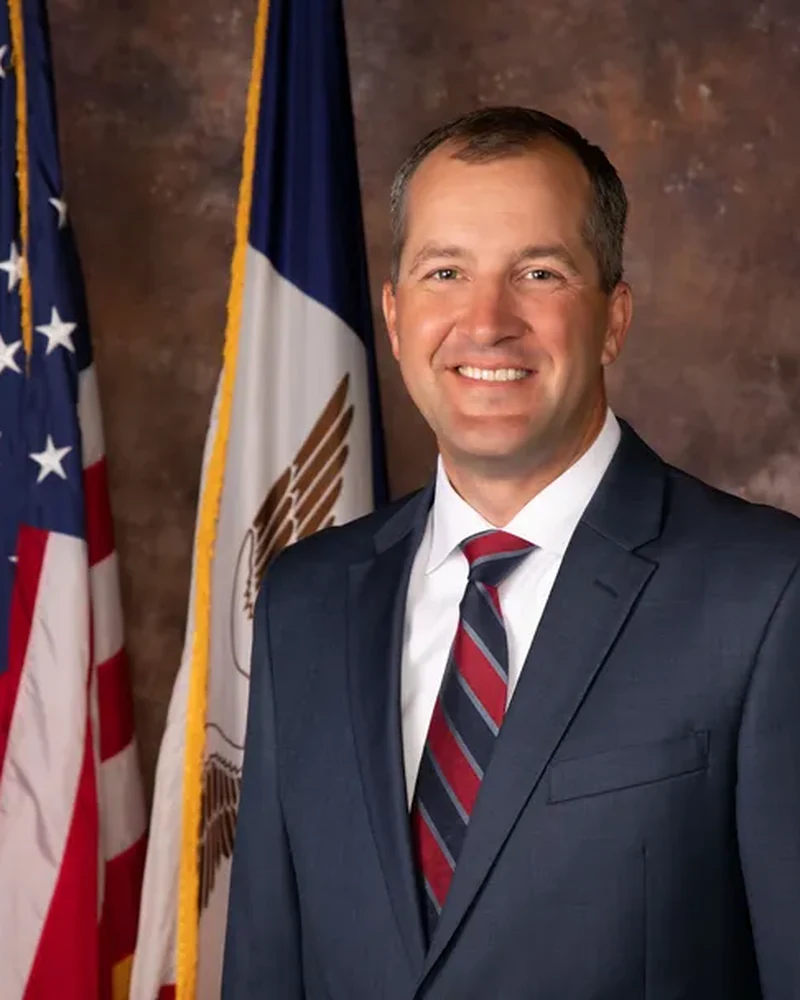
Iowa Secretary of Agriculture since 2018. Naig grew up on a family farm near Cylinder and previously worked in agribusiness and at the Iowa Department of Agriculture before becoming secretary.
State of Iowa / Iowa Department of Agriculture and Land Stewardship
Serving as Iowa Secretary of Agriculture since 2018.
Raised on a family farm in northwest Iowa.
Oversees state agriculture, conservation and food-safety programs.
Seeking another term in 2026.
Before joining the state agriculture department in 2013, Naig worked as Monsanto’s Manager of State and Local Government Affairs; Iowa legislative lobbyist records also list him for Monsanto in 2010.
Campaign ads, attacks and response media reviewed
Secretary of Agriculture · Mike Naig · conservation adoption claim · September 9, 2026
Naig’s “record-setting conservation adoption” claim is supported for cover crops, with important measurement context
What Naig said: In September 9 campaign remarks, Agriculture Secretary Mike Naig said Iowa has had “record setting conservation adoption” after state water-quality funding ramped up in 2021 and 2022.
What the record shows: Iowa State’s Nutrient Reduction Strategy tracking tool reports the Iowa Nutrient Research and Education Council agricultural-retailer survey at 1.60 million cover-crop acres in 2017, 3.77 million in 2022, 3.84 million in 2023 and 3.87 million in 2024. IDALS also reported that 2026 state cover-crop cost-share enrollment exceeded 1 million acres for the first time, including more than 300,000 acres in the Greater Des Moines Watershed.
Measurement caveat: Iowa State also publishes USDA Census of Agriculture estimates that are materially lower — 379,614 acres in 2012, 973,112 in 2017 and 1,282,608 in 2022. Those sources use different collection methods and time periods, so a single statewide acreage figure should identify its methodology. “Record-setting conservation adoption” is broader than cover crops alone and does not by itself establish that Iowa has met nitrate-reduction or water-quality outcome goals.
Assessment:Supported with measurement context. The strongest current cover-crop series reviewed shows near-record statewide acreage and substantial growth, while the broader claim should not be read as proof that every conservation practice or water-quality outcome is at a record.
EPA finalized 2025 refinery exemptions; Lahn and Naig are right that the promised follow-through is not yet a final reallocation rule
What changed: EPA has now issued final agency decisions on 34 petitions for 2025 small-refinery exemptions under the Renewable Fuel Standard. The agency says 29 refineries received full or partial exemptions covering 1.76 billion RINs.
Important precision: EPA did not say all 1.76 billion exempted RINs will simply be reallocated. The agency says it will propose by the end of October to reallocate 100% of the difference between projected and actual 2025 exempted volumes into the 2026 and 2027 Renewable Volume Obligations. EPA had projected about 990 million exempted RINs when setting those volumes, so the contemplated adjustment concerns the unanticipated gap, not the whole 1.76 billion.
Candidate/policy claim: At a Sept. 4 campaign stop, Republican gubernatorial nominee Zach Lahn and Agriculture Secretary Mike Naig said Iowa officials need to keep EPA accountable for its promised reallocation. That caution is supported by the procedural status: the exemption decisions are final agency actions, while the additional 100% reallocation step is still a future proposal and has not yet been finalized.
IA Fact Check assessment: Supported with procedural context. The federal waiver numbers are confirmed, and Lahn/Naig are correct that further EPA action is still required. Any wording implying EPA has already finalized the promised 100% additional reallocation would be premature.
Endorsement / agricultural-interest-group context · September 2, 2026
Iowa Farm Bureau PAC designates Mike Naig and Ashley Hinson “Friend of Agriculture”
The Iowa Farm Bureau Political Action Committee designated Secretary of Agriculture Mike Naig and U.S. Senate candidate Ashley Hinson as “Friend of Agriculture” candidates for the November 3 general election.
Farm Bureau says the designation reflects support for its policies, past voting/support records, and grassroots input from all 100 county Farm Bureaus. This is an endorsement by an agricultural advocacy organization, not an independent performance rating or a factual finding about either candidate.
IA Fact Check context: The designation is useful evidence of organized-agriculture support. It should not be read as proof that all Iowa farmers agree with the PAC or that any particular policy claim is true.
Naig says Iowa’s cancer crisis cannot be blamed on farmers alone; the evidence supports agricultural nitrate as a major water-quality source, not a one-group explanation for all cancer
What Naig said: At the Farm Progress Show, Agriculture Secretary Mike Naig said “playing the blame game” would not solve Iowa’s cancer crisis and argued that it is more complex than one issue caused by one group. Gray Media also reported that Iowa has largely relied on voluntary conservation programs rather than statewide mandates.
What the record shows: Polk County’s water-quality material says Iowa’s shift toward agriculture and urban land use has degraded rivers and streams, that high nitrate levels are of particular concern because of the large amount of agricultural land, and that pollutants can come from both agricultural and urban inputs. Polk County’s 2025 source-water assessment was designed as a broad scientific review of the Des Moines and Raccoon River systems.
Cancer precision: University of Iowa researchers report associations between nitrate exposure in drinking water and elevated risk for some cancers, including an ovarian-cancer association in a 2025 study. An association does not establish that “farmers” as a group caused Iowa’s overall cancer burden, which has multiple potential environmental, behavioral, genetic and health-system contributors.
IA Fact Check assessment:Supported with important context. Naig’s narrow point that Iowa’s overall cancer crisis cannot scientifically be reduced to one group is supported. But that does not negate evidence that agricultural nutrient losses are a major contributor to nitrate pollution in Iowa waterways or eliminate legitimate policy debate over whether voluntary programs have reduced pollution quickly enough.
Jones response: Democratic challenger Chris Jones told Gray Media that Naig’s approach spends taxpayer money without sufficient statewide water-quality improvement and called for different strategies. His quoted “as bad as it’s ever been” characterization is a campaign claim and is not independently proven merely by the Gray Media article; long-term monitoring trends are the appropriate evidence for that stronger assertion.
Developing refinery-waiver proposal puts renewed focus on RFS policy
What changed: Reuters reported Aug. 27 that the White House was considering a larger round of small-refinery exemptions from Renewable Fuel Standard obligations as officials looked for ways to ease gasoline prices. Farm and biofuel groups urged the administration not to expand the waivers, arguing that doing so would undercut demand for corn- and soybean-based fuels.
Naig’s existing position: After EPA finalized 2026–27 Renewable Fuel Standard volumes in March, Iowa Agriculture Secretary Mike Naig said strong biofuel volumes support Iowa crop markets, rural jobs and lower-cost fuel choices.
What is settled vs. developing: EPA’s finalized 2026–27 RFS volumes are a completed federal rule. The additional Aug. 27 refinery-waiver expansion described by Reuters was still under consideration in the sources reviewed; IA Fact Check does not describe it as a final EPA decision.
Agriculture / trade-policy context · August 23, 2026
Naig and Jones both criticize temporary beef-import expansion
Republican Secretary of Agriculture Mike Naig and Democratic challenger Chris Jones have both criticized the Trump administration’s temporary plan to expand lower-tariff beef imports, while emphasizing different concerns. Naig said Iowa needs affordable food “but not at the expense of cattle producers” and said he raised concerns about foreign beef imports directly with U.S. Agriculture Secretary Brooke Rollins during her State Fair visit. Jones called the additional imports a short-term “band-aid” rather than a long-term strategy for rebuilding the domestic cattle herd and argued that strong demand supports producer profitability.
The same federal policy was already documented in the U.S. Senate race after Ashley Hinson and Josh Turek criticized it. IA Fact Check records the Naig and Jones remarks as current agriculture/trade-policy positions, not as proof that either candidate’s forecast about future beef prices, herd rebuilding or producer income will occur.
Cancer / water-quality debate revisits pre-office Monsanto role
Sponsor: Independent reporting — The Guardian · Date: August 16, 2026
The Guardian’s Aug. 16 cancer/water-quality report notes Naig’s pre-government Monsanto role while contrasting candidates’ approaches to agriculture and water policy.
IA Fact Check assessment: Employment/lobbying history documented; policy motive or wrongdoing is not established
A 2013 Buena Vista University announcement says Naig had been Monsanto’s Manager of State and Local Government Affairs, and an Iowa Legislature lobbyist declaration lists Michael Naig for Monsanto Company in 2010. That is relevant background but does not by itself establish improper influence or wrongdoing.
Sponsor: Chris Jones campaign and allied commentary · Date: 2026
Jones and allies argue Naig has not done enough to reduce nutrient pollution and has been too aligned with large agricultural interests.
IA Fact Check assessment: Policy criticism — water-quality conditions are real; responsibility is contested
Iowa’s water-quality problems and nutrient-reduction targets are measurable, but attributing statewide outcomes to one officeholder requires context about legislative funding, voluntary and regulatory programs, weather, land use and federal/local roles. Naig points to conservation investments and programs including Choose Iowa and nutrient-reduction efforts.
Polling context · August 2026
Campaign-sponsored poll puts Naig–Jones initial ballot within margin of error
Change Research, polling for Chris Jones’s campaign from July 28 through August 1, surveyed 1,071 likely Iowa general-election voters. The initial ballot test found Mike Naig 42%, Chris Jones 40%, 16% unsure, within the survey’s stated ±3.1-point margin of error.
After respondents read positive biographical descriptions of both candidates, Jones led 46% to 40%, with 13% unsure. IA Fact Check treats that second result as an informed/message-exposed ballot rather than a neutral topline. The survey was commissioned by Jones’s campaign, so it is useful race context but not an independent election forecast.
This profile separates documented actions and quotations from campaign interpretation. Where an opponent uses a political label, the label is presented as advocacy rather than converted into a factual finding unless the underlying evidence supports the narrower claim.